أسعار الشوكولاتة في ألمانيا تقلب الموازين بين ليندت وميلكا

Chocolate prices in Germany: Lindt turns cheaper than Milka
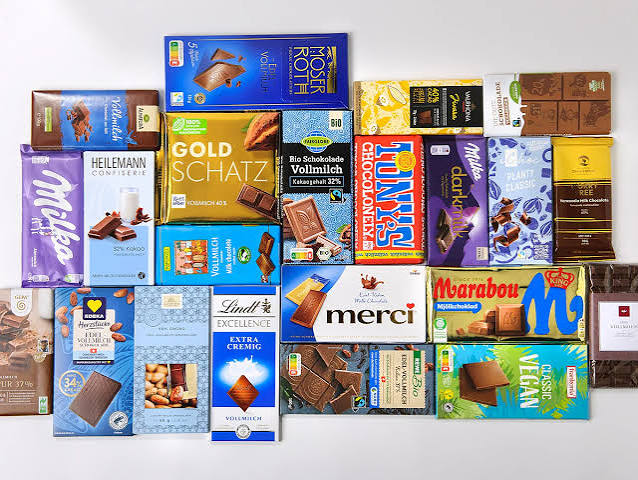
Tracking chocolate prices across leading European retailers has unveiled a historic disruption within the confectionery industry. According to in-depth investigations published by the Frankfurter Allgemeine Zeitung (FAZ) and German outlet T-Online, consumer grocery shopping is witnessing an unprecedented phenomenon: premium Swiss Lindt bars are frequently selling at retail prices lower than everyday mass-market Milka bars across major supermarket chains.
The Pricing Paradox in Grocery Retail
For decades, consumer segments adhered to a well-defined market tier where Milka served as an accessible, budget-friendly staple, while Lindt was positioned strictly as an upscale indulgence. However, aggressive price hikes executed by Mondelez International—the parent conglomerate of Milka—pushed standard purple-wrapped bars into an elevated price territory between €1.80 and €1.99. These steep adjustments were intended to absorb mounting production, logistics, and packaging expenditures.
Concurrently, selected retail campaigns and inventory schedules positioned classic Lindt tablets within an unexpected promotional bracket of €1.49 to €1.69 across supermarket chains like Edeka and Rewe. Consequently, everyday shoppers found themselves experiencing a reversed pricing architecture, where opting for a luxury confection became economically lighter on the household budget than purchasing conventional consumer sweets.
Executive Shakeup at Lindt & Sprüngli
This commercial anomaly rapidly escalated beyond retail shelves into executive boardroom drama. German business publication WirtschaftsWoche revealed that the supervisory board of Lindt & Sprüngli made the decisive call to dismiss Chief Executive Officer Adalbert Lechner. The executive departure followed intense friction regarding Lechner's assertive pricing directives implemented throughout his leadership tenure.
While Lechner aimed to preserve corporate operating margins amidst surging commodity pressure, the repeated price escalation triggered significant volume attrition. Consumers exhibited widespread resistance to elevated price points, resulting in measurable market share erosion and friction with supermarket distribution syndicates that resisted passing exorbitant costs onto cost-conscious shoppers.
Structural Pressures from the Global Cocoa Deficit
At the foundational core of this retail turmoil lies the international cocoa commodity crisis. Key agricultural corridors in West Africa—principally Côte d'Ivoire and Ghana, which together yield the vast majority of the world's raw cocoa—have faced devastating crop failures due to adverse climatic shifts and spreading agricultural disease. The resulting supply deficit propelled cocoa futures to unprecedented highs across global commodity exchanges.
This supply shock forced confectioners into complex trade-offs, oscillating between covert shrinkflation, product reformulation, and direct price increases. As consumers navigate these shifts, the German confectionery aisle illustrates how volatile agricultural supply chains can rapidly dismantle corporate strategies, invert longstanding consumer price hierarchies, and reshape leadership structures at the world's most established food brands.

Fadi Q
News writer and editor at Madar24, contributing to the preparation and editing of news and articles and the publication of digital content, with a focus on presenting clear, accurate, and up-to-date information to readers.
All articles by this authorRelated articles

Brighton West Pier Collapse Following Destructive Gales of Storm Austen
High winds and violent waves from Storm Austen trigger structural collapse at the Grade I listed Brighton West Pier along England's southern coastline.


Air Canada Phone Booking Fee: $30 Surcharge Sparks Outcry
Air Canada sparks backlash after imposing a non-refundable $30 fee per passenger for reservations made via call centers, igniting a fierce debate over a "boomer tax".